“Wait… I Have Astigmatism?” — Let's Simpli-fy It!
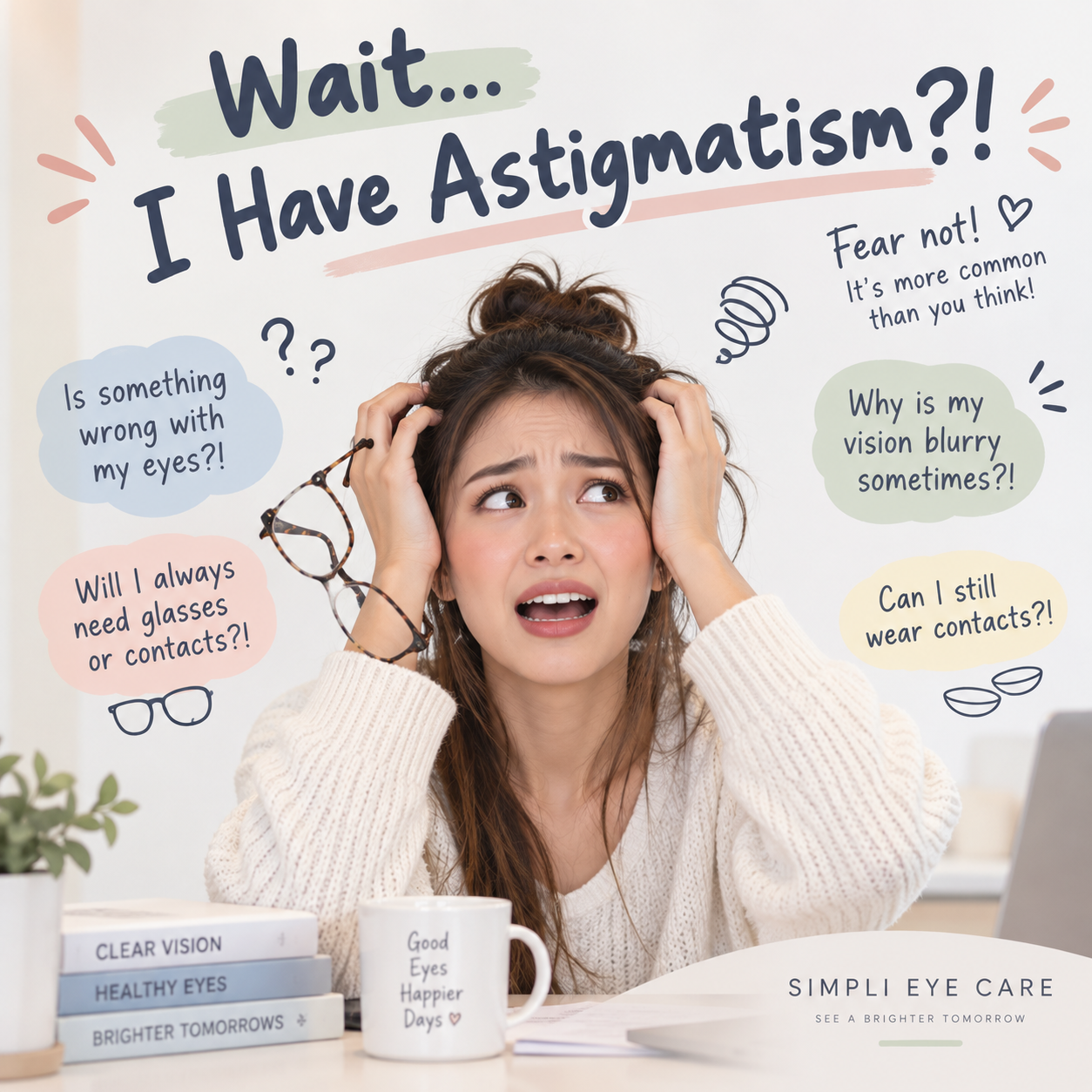
Fear not! It sounds much scarier than it actually is.
Astigmatism is one of those words that seems to make patients nervous. I'll casually mention, “You have a little astigmatism,” and sometimes immediately get: “Wait…is that bad?!”
Fear not! Astigmatism is extremely common, and for most people, it's simply another part of your glasses or contact lens prescription.
So What Is Astigmatism?
You've probably heard the classic explanation that a perfectly round cornea is shaped more like a basketball, while an eye with astigmatism is shaped a little more like a football.
That's not a perfect description, but it's an easy way to picture it!
Basically, the front surface of your eye has slightly different curves in different directions. Because of this, light doesn't focus exactly the same way in every direction, which can make your vision look blurry, smeared, or slightly distorted.
Some people especially notice it at night when looking at headlights or streetlights.
And some people don't notice it at all!
Is Astigmatism Bad?
Usually, no.
Most astigmatism can easily be corrected with glasses or contact lenses.
Some people have a tiny amount. Others have quite a bit. Having a higher number doesn't automatically mean your eyes are unhealthy—it simply means you need more astigmatism correction to see clearly.
This is also why I don't really like describing someone's prescription as “good” or “bad.” It's simply a measurement of what your eyes need.
Can I Wear Contacts If I Have Astigmatism?
Yes! There are soft contact lenses specifically designed to correct astigmatism, called toric contacts.
For certain people with more irregular corneas, traditional soft contacts may not provide the clearest vision. In those cases, specialty lenses such as rigid gas permeable (RGP) lenses or scleral lenses may sometimes be considered.
But most people with regular astigmatism don't need anything complicated.
When Do We Look Into It Further?
Astigmatism itself is very common, but sometimes a large amount or an unusual change in astigmatism may make your eye doctor want to take a closer look at the shape of your cornea.
There are conditions such as keratoconus, where the cornea gradually becomes thinner and changes shape, which can cause irregular astigmatism.
That does not mean having astigmatism means you have keratoconus!
It simply means your eye doctor looks at your prescription together with the overall health and shape of your eyes.
So…Fear Not!
The next time your eye doctor tells you that you have astigmatism, don't panic.
For most people, it's simply: “Your eye focuses light a little differently in different directions, so we'll correct for it in your prescription.”
That's really it!
And if you're curious about what the sphere, cylinder, and axis numbers actually mean on your prescription, check out my other article where I break down your glasses prescription one number at a time.
Still confused by all those numbers? Check out my guide: click here—where I break down SPH, CYL, and Axis one number at a time.
— Suzzane Li, OD, FAAO, ABCMO
Simpli Eye Care PLLC, Managing Optometrist