Understanding Contact Lenses
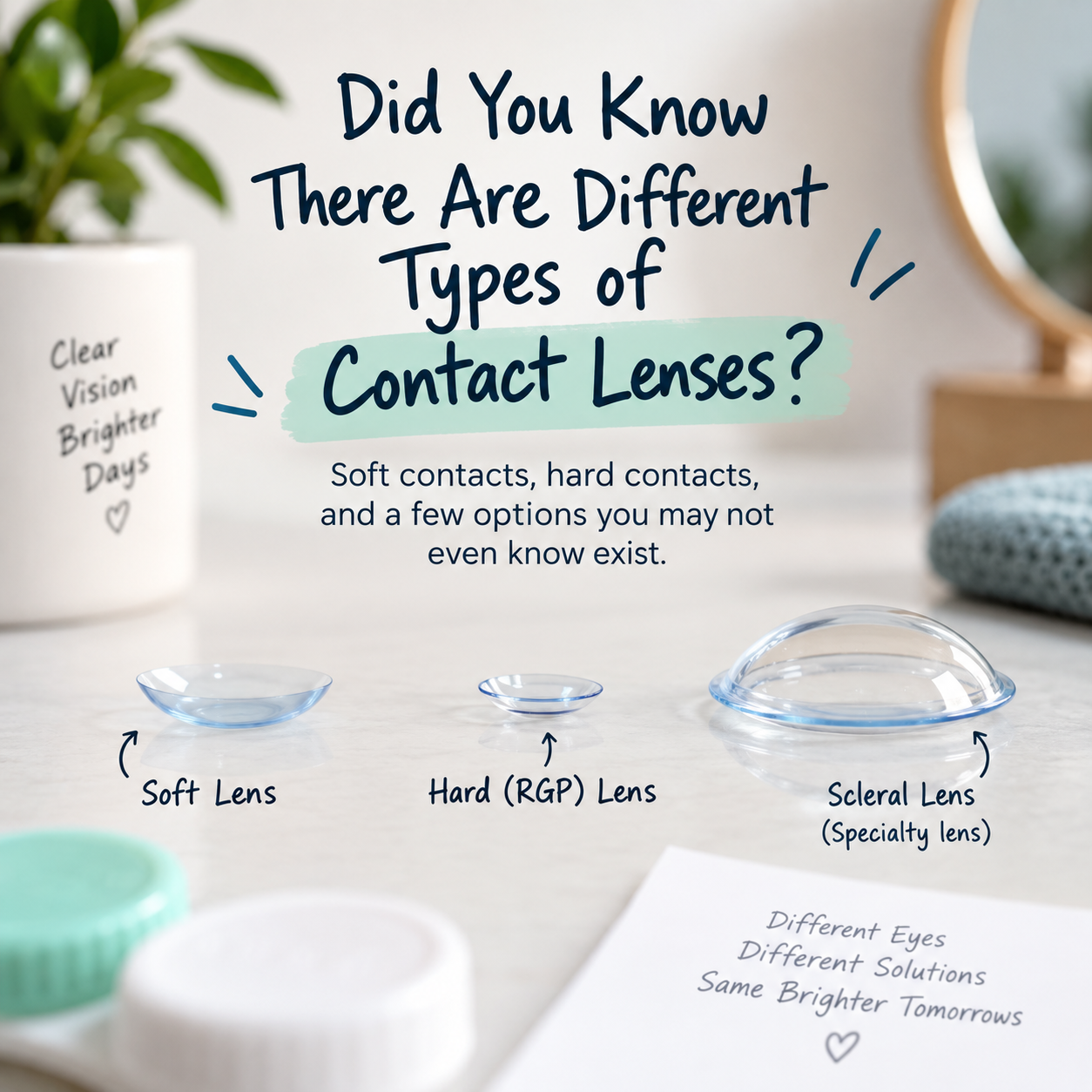
Did You Know There Are Different Types of Contact Lenses?
Soft contacts, hard contacts, and a few options you may not even know exist
When most people think about contact lenses, they probably picture the little soft lenses that come individually packaged in a box.
Those are the contacts most of us know—and they're great for a lot of people! They're comfortable, convenient, and can correct nearsightedness, farsightedness, astigmatism, and even help with distance and reading vision as we get older.
But something patients are sometimes surprised to learn is that soft contacts are only one type of contact lens.
There are soft lenses, hard lenses, and even much larger specialty lenses designed for certain eye conditions.
So let's talk about them!
First, the Contacts Most of Us Know: Soft Lenses
Soft contact lenses are thin and flexible. They drape over the surface of the eye and are usually pretty easy to get used to.
Depending on the lens, you may throw them away every day or replace them every couple of weeks or once a month.
For most contact lens wearers, a regular soft lens may be all they ever need.
And honestly, that's great!
I don't believe in making things more complicated than they need to be. If a simple soft contact gives you clear vision, good comfort, and healthy eyes, that's a great contact lens.
So What Is a “Hard” Contact Lens?
Whenever I mention hard contact lenses, I sometimes get a look that says: You want me to put WHAT in my eye?
The name makes them sound a little scarier than they actually are.
Modern hard contacts are usually called rigid gas permeable lenses, or RGP/GP lenses. Unlike a soft lens that bends easily and follows the surface of the eye, an RGP holds its shape.
And sometimes, that's exactly what we want.
Why Would Someone Need a Hard Contact?
Here's an easy way to think about it.
The clear front surface of your eye is called the cornea. Ideally, it has a nice, regular shape.
But not everyone's cornea is perfectly regular.
Imagine putting plastic wrap over a bumpy surface. Because the plastic is soft, it follows the bumps underneath it.
A soft contact can behave somewhat similarly.
A rigid contact is different because it maintains its own smooth shape. For certain eyes, that can create a smoother surface for light to travel through and sometimes provide clearer, better-quality vision than glasses or a traditional soft contact can provide.
That's why some people who don't see as clearly as they'd like with glasses or soft contacts may actually do very well with a rigid lens.
Sometimes the problem isn't simply:
“What prescription do you need?”
Sometimes the shape of the eye itself is affecting the vision.
Hard Contacts Are Fitted Differently
This is where fitting a hard contact becomes a little different from fitting a regular soft lens.
With an RGP, we need to pay close attention to the shape and curvature of your cornea because the way the rigid lens sits over your eye can actually affect the final prescription you need.
So we're not simply asking: “What power should I put in this contact?”
We're looking for the right combination of lens shape, fit, and prescription for that particular eye.
That's also why a hard contact lens fitting can take more time than a traditional soft contact lens fitting. Sometimes we try a lens, evaluate how it sits on the eye, check the vision, make an adjustment, order another lens, and then check everything again. There may be several follow-up visits before we're completely happy with the vision, comfort, and fit. That doesn't necessarily mean something went wrong.
That's part of the fitting process.
Every eye is a little different, and sometimes your eyes make us work for it.
Already Wearing Hard Contacts?
If you already wear RGPs, please bring your current lenses and any previous contact lens information you have to your appointment.
Knowing your old lens parameters can definitely be helpful.
That being said, I generally prefer to remeasure the eye and look at how the lens fits today rather than automatically keeping the same lens shape and simply changing the prescription.
Eyes can change over time.
Sometimes your existing lens design is still exactly what you need. Other times, the curvature of your cornea or the way your lens fits may have changed.
I like to look at the eye as it is today and decide from there.
And if you don't have all of your old contact lens information, don't panic. We can take new measurements and start from there.
What About Those Really Big Hard Contacts?
You may have seen pictures online of very large rigid lenses called scleral lenses. They look HUGE compared with regular contacts.
A scleral lens is a type of rigid contact lens that vaults over the cornea and rests on the white portion of the eye, called the sclera. The lens is filled with preservative-free saline before it's placed on the eye, leaving a layer of fluid between the lens and the cornea.
These lenses can be extremely useful for certain patients with conditions such as keratoconus, very irregular corneas, significant ocular-surface problems, or other complex eye conditions.
And despite how intimidating they may look, many patients actually find them quite comfortable once they're properly fitted.
One important note:
We DO NOT currently fit scleral lenses at our Costco location.
Scleral fittings require specialized fitting materials that we don't currently have access to at our practice. However, there are other eye-care providers in Tucson who do offer scleral lens fittings.
I still think they're worth talking about because I want patients to know these lenses exist.
If your eyes need something beyond what we're able to provide, sometimes the best thing we can do is help you understand that there may be another option worth exploring.
There Are Even More Types of Contacts
And because apparently contacts weren't complicated enough already…
There are toric contacts for astigmatism, multifocal contacts for distance and reading, hybrid lenses that combine a rigid center with a softer outer portion, and Ortho-K lenses that temporarily reshape the cornea.
There are also highly customized lenses used for certain medical and cosmetic purposes.
You definitely don't need to memorize any of this. The important thing to know is: Contact lenses aren't one-size-fits-all.
Two people can have very similar glasses prescriptions and still need completely different contact lenses.
Why Do Contacts Need Their Own Prescription?
This is another thing people sometimes don't realize.
Contact lenses are considered medical devices, and we're putting them directly onto the surface of your eye. So during a contact lens evaluation, we're looking at more than whether you can read the 20/20 line.
We're also looking at: Does the lens fit properly? Is it moving the way it should? Is it comfortable? Does your cornea look healthy? And is it actually giving you good-quality vision?
That's why your contact lens prescription isn't necessarily the same as your glasses prescription.
Interested in Hard Contacts at Simpli Eye Care?
At Simpli Eye Care, we do fit traditional hard/RGP contact lenses.
If you're interested in being fitted for hard contacts, please tell our staff specifically when you're scheduling your appointment.
I personally handle our hard/RGP contact lens fittings, and these appointments need to be scheduled differently from a routine soft contact lens evaluation so that we have enough time for the additional measurements and fitting.
When you call or text us, simply let our staff know: “I'm interested in a hard/RGP contact lens fitting with Dr. Li.”
That way we can make sure you're scheduled for the correct appointment.
If you're specifically looking for a scleral lens, please mention that too. We don't currently fit scleral lenses at our office, but knowing what you're looking for prevents you from being scheduled for the wrong type of appointment.
“I Was Told I Can't Wear Contacts.”
This is one of the biggest reasons I wanted to write this article.
Sometimes a patient tells me: “I can't wear contacts.” And after talking a little more, what they actually mean is: “I tried one type of soft contact years ago and it didn't work.”
That doesn't necessarily mean another type of contact will work either. There absolutely are people whose eyes aren't good candidates for contact lens wear.
But there are more contact lens options than many people realize.
So if you've struggled with contacts in the past—or you have an eye condition that makes your vision difficult to correct—it doesn't hurt to ask: “Are there any other types of contacts that might work for my eyes?”
Sometimes the answer may still be no. But sometimes there may be an option you didn't even know existed.
One Last Thing: Please Take Care of Your Contacts!
I can't write an entire blog about contact lenses without sneaking this in.
If you wear reusable contacts, clean them properly and replace them according to the schedule recommended for that particular lens.
Please don't turn your two-week contacts into: “Hmm…I don't actually remember when I opened these.”
And please keep contact lenses away from tap water, swimming pools, hot tubs, and shower water. Contact lens infections can become serious.
If your eye becomes painful, unusually red, very sensitive to light, or your vision suddenly changes, take your contacts out and have your eyes evaluated rather than trying to push through it.
The Right Contact Is the One That Works for Your Eyes
Most people don't need specialty contacts.
If a simple soft contact gives you fantastic vision, feels comfortable, and keeps your eyes healthy, that's wonderful.
But I want people to know that the contact lens world is much bigger than the little boxes of soft lenses we normally see.
A “hard” contact isn't necessarily an outdated version of a soft contact.
It's simply a different tool designed for a different type of eye.
And sometimes an eye that's a little more complicated just needs a different tool.
— Suzzane Li, OD, FAAO, ABCMO
Simpli Eye Care PLLC, Managing Optometrist